Research
The Codes + Conventions of a Documentary
- Voiceover = The voiceover encourages the audience to think they have the correct opinions of a subject. An example of this is David Attenborough in the BBC's Planet Earth II who informs the audience about elements of life on planet Earth. This can change the audience's opinion on different aspects of life on planet Earth.
- 'Real' footage of events = Events are portrayed to the audience as real by filmmakers going to great lengths to get unaltered footage even though, a voiceover can ruin this. An example of this is Blackfish which includes footage of trainers tarining whales. This informs the audience of the nature of the job a trainer has at Sea World.
- Archive Footage = Video that is used in other productions. It can be images of cities, landmarks, historical events, images of a natural landscape. Archive footage can also refer to news footage. An example of this is in Bowling for Columbine which shows footage of gun shootings in America. This will encourage audiences to think twice about carrying a gun when they see the consequences which include the deaths of innocent people.
- Interviews = Can be either direct or indirect. Direct interviews involve asking questions in a way that the responder understands the purpose of the questions and the intended purpose. Indirect interviews involves asking questions when the responder is unaware of the purpose or intended response. An example of this is in Blackfish which includes interviews with members of the public. This allows the audience to easily relate to the documentary because they are seeing ordinary people's opinions instead of just professionals.
- Montage = Carefully edited, selected pieces of film to form a continuous whole. An example of this would be On The Edge And Online which begins with a montage of people who describe their mental health issues. This will make the audience feel sympathy for the subjects of this documentary.
- Contrasting Characters = Characters who are different to one another. Used by producers to gather different opinions on a subject. An example would be in Bowling for Columbine where the opinions on guns between the filmmaker and the rest of the USA contrast each other. This will make the audience think twice about carrying a gun.
- Archetypal Characters = Characters who are used to represent a wider range of people, their views and opinions. This is also known as a 'stock character'.
- Cross-cuts = The camera cutting away from one action to another to give the impression of the action occuring simultaneously.
- Jump-cuts = A cut in film editing that gives the impression of the subject "jumping" forwards in time.
- Dialogue = The conversation that occurs between many people in a film. Duologue refers to conversation between only two people.
- Confessional Monologue = A direct to camera 'confession' from a character in the film. In a documentary, this occurs in response to a particular action or event.
- Cinema Verite = Where the camera records people without directorial input. Often reffered to as observational filmmaking.
- Monomyth = A basic monomyth is where a hero begins in an ordinary world and they are called into a world of strange events. They face tasks in this world, either alone or with assistance. If they survive, they achieve a great gift. They then decide whether to return home with the gift. If they decide to return, they face challenges on the journey. If they return successfully, the gift may be used to improve the world.
Modes of Documentary
- Poetic = This mode will seem more suggestive and use 'associative' editing to capture a mood or tone rather than make an explicit argument about the subject. Evoking a mood rather than stating or asserting things directly. Occasionally, you may question whether you are indeed watching a 'documentary'. An example would be Rain (1929), where there is a continual switch from rain falling on the ground to the public's reaction to the rain.
- Expository = These documentaries use explicitly rhetorical techniques in order to make points about aspects of actuality. This mode often uses voiceover and has a relatively straightforward 'show and tell' structure to guide the viewer through the material. Many documentaries follow this template (especially TV documentaries) where the voiceover provides the connection, the logic, between what might be different shots. An example would be the BBC's Blue Planet II (2017), where David Attenborough is showing how plastic in the ocean is killing life in the ocean.
- Observational = The direct address of expository may be contrasted with the observational model, where the documentary appears to take a neutral stance towards its subject matter. Overtly interpretative techniques such as voiceover or music are avoided in favour of an apparent capturing of reality. An example would be Rain (1929), where there is no sound. This documentary focuses on the observation of people's reaction to rainfall.
- Reflexive = The reflexive mode attempts to offer a commentary on the means of representation. A reflexive documentary uses techniques that encourage the viewer to question the very idea of the documentary as a category or mode. This questioning can also lead to a critique of other things such as 'cinematic realism'. An example would be Driving Me Crazy (1988) because it conveys real-life by portraying rehearsals for a play.
- Participatory/Interactive = A documentary where the filmmaker doesn't remain distant from the subject matter, but actively engages with it by openly participating or interacting with the people and institutions on show. This documentary form is far removed from the detached (observational and poetic) or the straightforward didactic (expository). An example would be Emma Willis Delivering Babies (2018) where Emma Willis becomes actively involved in delivering babies.
- Performative = The most confusing modes, performative documentaries raises questions about filmmaker and subject performance - the notion of the filmmaker and their subjects actively creating the documentary by performing certain actions. The performance of the documentary maker is central to the way the documentary is constructed. An example would be Ross Kemp: Extreme World (2014) as Ross Kemp has a large role in choosing the issues that are explored in the series.
Black Fish - Analysis
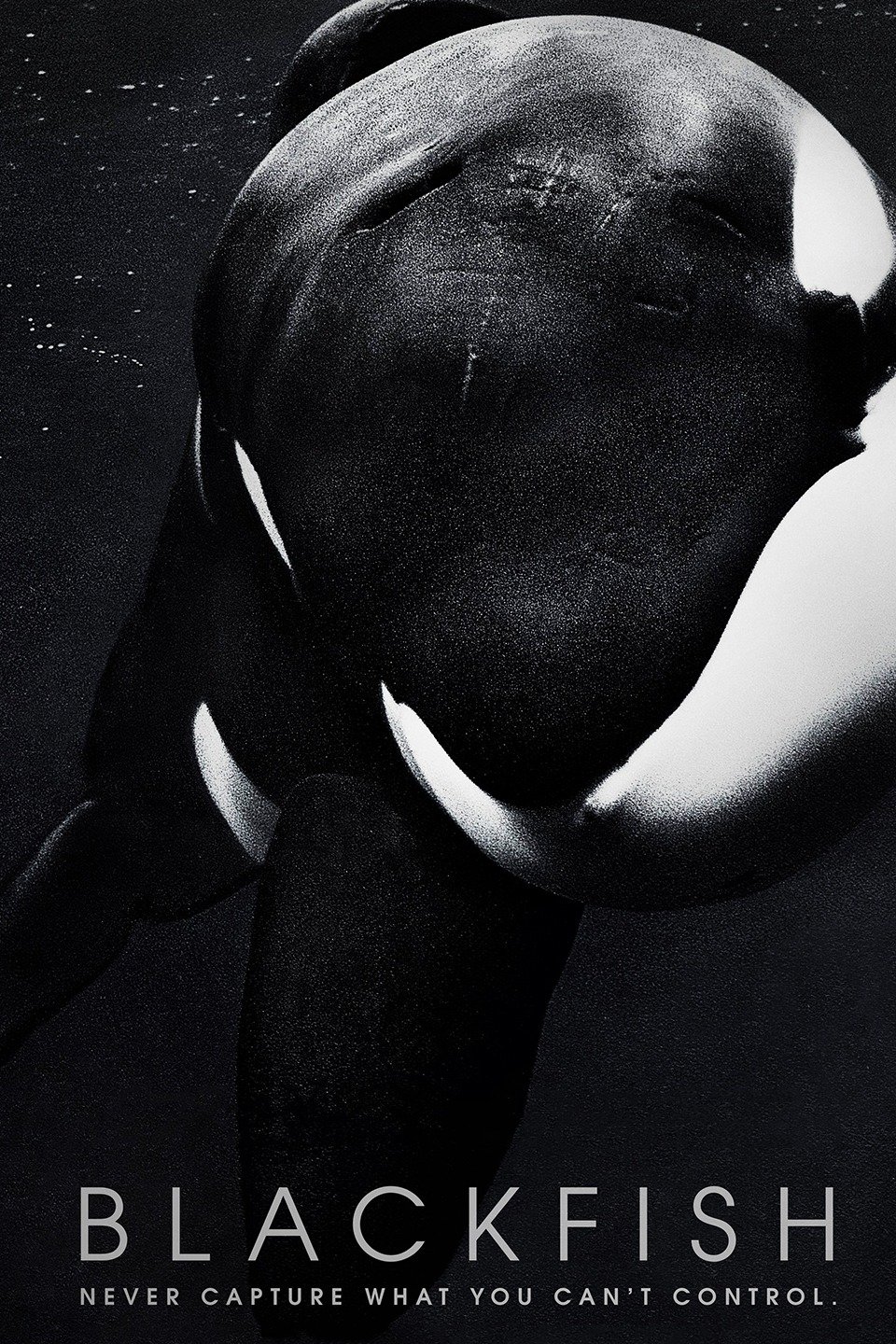
'Black Fish' has aspects relating to the expository and observational modes of documentary because there is no voice and it provides a show and tell style through interviews with experts, ex-staff of Sea World. The structure of the narrative revolves around how whales kept in captivity have resulted in the deaths of three people who work with them. Using this narrative, the filmmaker was effective in conveying a message that animals like whales should not be kept in captivity. The use of micro-elements such as sound helps to build up tension in the audience and gives them the idea that something bad is going to happen. Also, the use of close-up footage of the whales allows the filmmaker to capture up-close footage of the whale which couldn't be seen up-close by any human in real-life. The theme of this documentary raises the message that whales should not be kept in captivity, because they get angry over time, which risks the safety of the humans who work with them.
Bowling for Columbine - Analysis
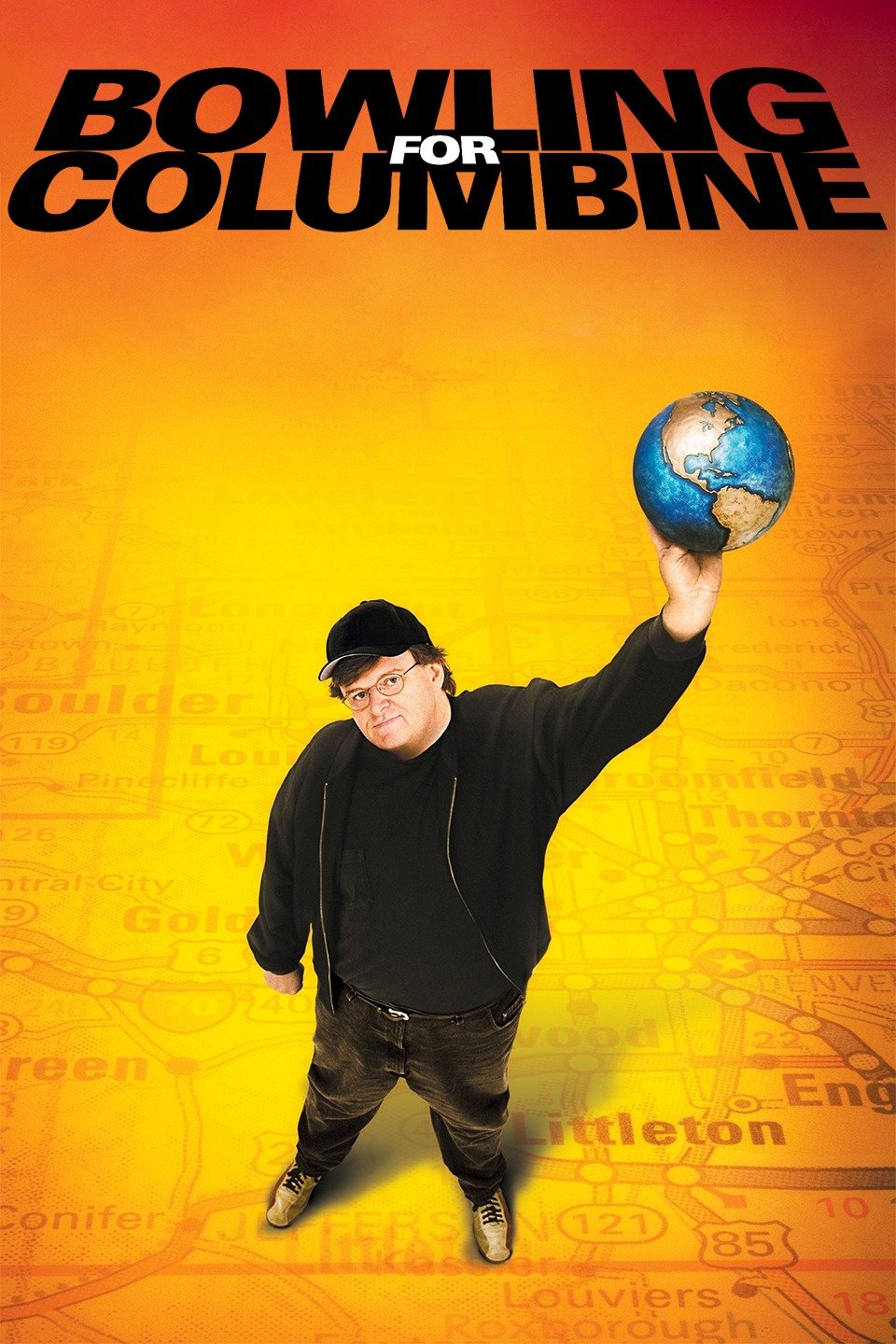
'Bowling for Columbine' has aspects relating to the participatory, monomyth and observational modes of documentary because this documentary contains footage of reality and also, the filmmaker reflects upon what he has seen of gun violence around the USA and indirect interviews with members of the public and participates in making sure that no more guns or bullets for guns are sold and that gun use is abolished. The structure of the narrative revolves around the filmmaker, Michael Moore, suggesting the causes of gun violence and the 1999 Columbine High School massacre. Using the narrative, the filmmaker was effective in conveying a message that the use of guns should be outlawed in the USA. The use of micro-elements such as editing allowed the filmmaker to combine the media's reactions to gun shooting such as news reports, adverts and comedy sketches with real-life footage of events. The theme of the documentary raises the message that the use of guns and weapons should be abolished for the safety of the human race.
Comparison of the two documentaries
Both documentaries raise a similar message in the sense that they both raise issues that urgently need to be eradicated for the safety of the human race, so in 'Black Fish', the filmmaker raises the message that whales should not be kept in captivity because they grow angry over time and this anger endangers the human race. However, in 'Bowling for Columbine', the filmmaker raises the message that gun use should be abolished because innocent humans are endangered. In 'Bowling for Columbine', the filmmaker, Michael Moore, has a more participatory role in the documentary as he makes it his job to persuade a weapon dealer to stop selling weapons. However, in 'Black Fish', the filmmaker takes a more observatory role in the documentary as the filmmaker focuses on filming close-up footage of the issue, rather than telling the story from a narrator's perspective. In addition, 'Bowling for Columbine' uses editing to combine the media's reaction to gun shootings with real-life footage of the shooting. However, 'Black Fish', uses sound to build tension and give the audience the idea that something bad is going to happen. Finally, the narrative for 'Black Fish' revolves around the filmmaker showing the audience how whales kept in captivity can cause harm to humans whereas the narrative for 'Bowling for Columbine' revolves around the filmmaker trying to eradicate gun use.
On The Edge And Online - Analysis
'On The Edge And Online' has aspects relating to the poetic mode of documentaries because it immediately captures an intense mood. The plot revolves around a group of people who suffer from different mental illnesses such as anorexia, OCD etc. Using the narrative, the filmmaker was effective in showing how this group of people have their own individual stories about their mental health and how they deal with it. The use of micro-elements such as editing allow the editor to combine footage of the people communicating with each other through online video calls and footage of each of them in their everyday lives with interviews about how their mental health affects their everyday lives. Interviews are a key part of this documentary as it shows two different young people talking to each other about their different mental health issues. The theme of this documentary will encourage the audience to open up conversations with friends and family about their mental health.
Research on mental health
After choosing my topic, I did some research into my topic of men's mental health. According to an article by Ask Men, the biggest killer of men under the age of 45 is suicide. After reading this, I read an article from The Independent, the waiting time for counselling on the NHS is 2 years. Secondly, for one of my reconstructions of the loss of a child, I looked on NHS Website to get an idea of how this subject is approached.
Interviews in Documentaries
- The purpose of an interview in a documentary is to get a professional or a member of the general public's opinion on the subject. Interviews can be held in a formal and informal way.
- Formal interviews are held in a formal setting (e.g. a studio) and it provides a person's opinion most likely after an event. Also, the interviewer will have planned what questions they want to ask.
- Informal interviews happen at the scene when the action is happening and they are only planned to a certain degree.
Step-by-step guide to planning an interview
1). Prepare questions - Plan what you want to ask your interviewee and what information you want to get out of them. Avoid questions that are too direct!
2). Be spontaneous - Ask questions that will veer off the main interview if an interesting point is made
3). Make sure the interviewee is comfortable - Ask easy questions to warm the interviewee up, anything that will get them talking and comfortable
4). Don't give out specific questions in advance - Don't give the interviewer your questions because if you do, they will memorize their answers and you lose spontaneity. Your interview will end up feeling unauthentic.
5). Don't speak - Stay quiet when the interviewee is talking. It's good to nod or give facial expressions. Just no sound
6). Ask for a final comment - At the end, always ask for any final thoughts and if anything was missed.
Questioning Techniques
Open questions - When the question doesn't have a "yes" or "no" answer but it can be answered in many different ways
Closed questions - When the question can be answered with a simple "yes" or "no" or a short sentence.
Single questions - When a question can only be answered in one way.
Multiple choice questions - When a question can be answered in multiple different ways.
Direct questions - When a question is asked in a direct way.
Suggestive questions - When a question implies a certain answer should be given.
Interview Structuring
The interviewer introduces themselves to the interviewee and gives them a brief outline of what they will talk about. The interviewee will be relaxed into the interview with easy questions and then, they will be asked questions on the topics. Upon receiving answers to the questions, the interviewer may ask questions that go off topic slightly. At the end of the interview, the interviewer will ask for any final thoughts or if any points have been missed in the interview.
How do creative choices affect our perception?
In this essay, I’m going to discuss how creative choices in a film, or a TV show can affect our perception as a viewer. In my opinion, I believe that the way a filmmaker chooses to portray a subject in a film, or a TV show can change the audience’s perspective on that subject and the way they act towards people affected by this subject.
An example is the BBC’s Blue Planet II (Attenborough, 2017), an expository documentary about life in Earth’s oceans. This TV documentary raised the issue of how plastic pollutes the ocean and kills life in the ocean, which is an issue that is rarely raised on television. This is evident by the filmmaker capturing a variety of different shots of how various sea life were getting stuck plastic waste and dying because they were suffocating. The purpose of this was to “issue[s] a warning to viewers, detailing how overfishing, plastic pollution, and climate change are all damaging ocean habitats” (Shepherd, 2017). Secondly, the use of the non-diegetic narrator, David Attenborough, who is a naturalist, has a huge influence on the audience’s opinions because the audience will trust his opinions. In consolidation of this, the producer’s choices would affect the audience’s perspective on disposal of plastic because Blue Planet II has raised the issue of how plastic is adversely affecting our environment and killing other life on planet Earth so therefore the audience would be encouraged to reduce plastic usage.
A second example is BBC soap opera EastEnders (Yorke, 2018), which tackled a storyline about knife crime in 2018 (BBC News, 2018). The producers of the show were successful in raising this subject because they were adamant that they portrayed the effects a stabbing can have on a family in real time and they broadcast an episode “featuring accounts from relatives of real-life victims of knife crime”, giving this episode of the show a poetic feel. Secondly, the use of non-diegetic sound in this episode was used to portray the real-life stories of knife crime victims, which is used to evoke emotion in the audience as they will feel saddened for the characters portrayed as they are portrayed so close to real-life. Thirdly, the representation of the younger generation being the main victims of knife crime as well as the main assailants will attract a younger audience to watch the scenes and then they’ll be encouraged not to carry a knife or to be careful with the social group they choose to mix with. Finally, the producers ensured that the storyline was written in an authentic way to make sure that it reflected real-life by taking inspiration from real-life stories such as the story of former EastEnders actress, Brooke Kinsella, losing her 16 year-old brother after he was stabbed to death. She believed that raising the issue of knife crime on a TV show like EastEnders would be “worth while if it helps” (BBC News, 2018). In consolidation of this, the producer’s choices would affect the audience’s perspective on knife crime as it has raised the issue of too many people in the UK being killed as a result of knife crime and too many people carrying knives so therefore the audience would be encouraged to think twice about carrying a knife around with them.
A third example is On the Edge And Online, a poetic documentary about the mental health issues of a group of young people. The filmmaker was successful in raising this issue because they show different stories from male and female perspectives, which allows the documentary to reach out to a wider audience. Secondly, the filmmaker's use of non-diegetic sound to portray the stories of these young people helps to create an emotional mood for the documentary. Thirdly, the representation of how young people deal with their mental health issues in everyday life helps to reach out to a younger audience because they will be able to easily relate to some of the issues in which some of the people in this documentary suffer from. The filmmaker's choices would affect the audience's perspective on mental health in the younger generation because it has raised the taboo subject of several mental health issues and it raised awareness of these different issues to an older generation so therefore, a conversation can be opened between the older and younger generation about mental health and both generations can be more open towards each other about their emotions.
In conclusion, I believe that creative choices made the filmmaker can affect the way we perceive a TV show or a film because the way in which a TV programme or a film is shot and edited together can make the audience look at a subject from a different perspective than what they originally did so therefore they may change their opinion towards that subject. Secondly, the representation of the group of people appearing in the documentary can change the perspective of the audience because often people follow stereotypes for different groups but media has the power to change these stereotypes because it allows people to voice their opinions on a much wider scale than what they previously have. Then, after having listened to these opinions, an audience is able to think differently about the subject and talk differently towards people who are affected by this issue. Finally, the use of non-diegetic sound can evoke emotion from the audience because they are able to view the emotion felt by the narrator or filmmaker about the subject.
Page Break
Bibliography
Attenborough, D. (Director). (2017). Blue Planet II [BBC TV Programme].
Shepherd, J. (2017, December 10). Blue Planet II: David Attenborough offers stark warning against climate change and pollution during finale. Retrieved February 6, 2019, from The Independent: https://www.independent.co.uk/arts-entertainment/tv/news/blue-planet-2-david-attenborough-climate-change-pollution-finale-a8102206.html
(BBC News, 2018)
Yorke, J. (Producer). (2017) EastEnders [BBC TV Programme]
Great start Jack! You have effectively define the modes of documentary and discussed how they individually affect the audience. You have analysed two documentaries use of techniques and approaches. You have outlined the purpose of interviews with documentaries, to expand on this include the practice interview you conducted and reflect on what you can do to improve for your project (i.e. questioning, framing, white balance, etc.).
ReplyDeleteAnother area to improve is your subject research, you have a basic analysis of a mental health documentary. I would like you to discuss how it uses documentary techniques, then relate that to your project. For example, if they are conducting interview a certain way, then why do you think they are doing that way and will you do something similar?
Also, it’s clear that you have looked into the statistics of mental health in men, I’d like to know where you got that information and how you are using it in your documentary.
Thank you for your feedback, Justin! Acting on your feedback, I have discussed how elements of the documentaries I have researched could be incorporated my own documentary. Also, I have incorporated links to the websites where I researched facts into men's mental health.
Delete